Tuesday, December 30, 2014

At least seven bodies found as rough weather hits QZ8501 search

SURABAYA, Indonesia: Seven bodies have been recovered from the Java Sea as a multi-nation recovery effort resumes it fits and starts because of rough weather on Wednesday (Dec 31) following the discovery overnight of wreckage from AirAsia Flight QZ8501 that went missing at the weekend.
Four bodies were recovered Wednesday morning, taking the figure to seven in two days, but rough weather has hampered the search in the sea and delayed the ability of air and water craft to bring the victims to Surabaya where relatives are waiting along with hospital staff and debris to a processing centre onshore at Pangkalan Bun in Kalimantan, according to Bambang Soelistyo, the head of Indonesia’s National Search and Rescue Agency, and other personnel.
"We are experiencing bad weather now. Rains and winds prevented us from resuming the search operation this morning," air force rescue coordinator SB Supriyadi told AFP.
Personnel from Singapore's navy have arrived at the scene and were given a more defined search area to work with - about 600 nautical miles from Singapore, according to Channel NewsAsia's Lam Shushan.
In Surabaya, ambulances are on hand and Bhayankara Hospital says it is "100 per cent ready" to receive the bodies of the victims.
SEARCH FOR PLANE WRECKAGE
The flight from Surabaya in Indonesia to Singapore went missing Sunday and took nearly three days to discover debris from the passenger jet and a related aerial sighting of the suspected aircraft on the sea floor, which AirAsia confirmed as the downed aircraft.
Mr Soelistyo said earlier that an air force plane Tuesday spotted a "shadow" on the seabed believed to be the missing AirAsia jet. "God blessed us today," Mr Soelistyo told a Tuesday press conference.
The aircraft is believed to be in an area of the sea where depths range from 25m to 30m, though it the fuselage may be broken in parts and debris scattered over a wide area, marine salvage experts say.
The Wall Street Journal reported Wednesday that Indonesia's search-and-rescue agency has obtained a sonar image that it says may be the body of the missing AirAsia jet on the floor of the Java Sea - reportedly showing an airplane upside down on the ocean floor in 24m to 30m of water. The image was obtained Tuesday by an Indonesian Navy ship that is part of the search-and-recovery effort, the agency said in a release early Wednesday morning.
AirAsia CEO Tony Fernandes travelled to Surabaya on Tuesday and pledged to "do whatever we can do" to help grieving relatives and friends, adding that his heart was "broken".
"The passengers were on my aircraft and I have to take responsibility for that," he said, adding that he was focusing on supporting the families. "It's an experience I never dreamt of happening and it's probably and it's probably an airline CEO's worst nightmare," Fernandes said.
Indonesian President Joko Widodo, also speaking in Surabaya on Tuesday where distraught relatives were being offered information and help by AirAsia and local authorities, offered his prayers.He said that recovery would resume in full force as soon as possible as the heavy seas hampered efforts. Widodo said he had flown over areas where wreckage and bodies have been recovered and thanked emergency personnel and volunteers for their work.
The plane lost radar contact on Sunday with Singapore, Malaysia, Indonesia, Australia and the United States sending ships and planes along with other equipment to help in the search. China, India and South Korea as well as New Zealand also offered help.
CNA

Myanmar drug trafficker arrested in SW China

KUNMING - A suspected Myanmar drug trafficker was arrested by Chinese police on Monday in southwest China's Yunnan Province, local authorities announced.
Sixteen bars of heroin weighing 8.3 kg were found wrapped with tape in the backpack of a Myanmar woman at about 10 a.m. in the Cangyuan county, according to the border police.
The woman confessed that she was promised a return of 5,000 yuan (817 U.S. dollars) to bring the drugs to China. She illegally crossed the border and got on a car but was intercepted by the police.
Cangyuan borders on Myanmar and is very close to one of the major drug sources in the world, the Golden Triangle.
Drug trafficking is a felony in China. Those convicted of trafficking more than 50 grams of heroin can face capital punishment.

Joint operations likely with Myanmar

The external affairs ministry is mounting pressure on Myanmar to carry out joint military operations to bust the hideouts of Indian insurgent groups operating from their uninhabited hilly terrain adjoining the border with India.
Disclosing that top NDFB and Ulfa rebels are taking refuge in Myanmar, security sources said that nearly 150 NDFB cadres, 200 of Ulfa and more than 1,500 rebels of Manipur-based militant outfits are holed up in Myanmar.
Informing that NDFB was about to start training of 80 new recruits in the hills of Myanmar in December, security sources said that NDFB self-styled military commander I.K. Songbijit and general secretary and finance secretary of the outfit are also in Myanmar camp. Clarifying that India was insisting for a joint operation with Myanmar, security sources said that in the past, the Myanmar Army claimed to have carried out operations to flush out camps of Indian insurgents.

Saturday, December 27, 2014

Hundreds protest against China-backed mine in Myanmar

Around 500 people protested near the Chinese consulate in Myanmar's central city of Mandalay demanding the closure of a flashpoint copper mine.

YANGON: Around 500 people including dozens of Buddhist monks protested near the Chinese consulate in Myanmar's central city of Mandalay on Saturday (Dec 27) demanding the closure of a flashpoint copper mine.
It was the largest protest since the fatal shooting of a woman demonstrating against the Letpadaung mine in the northwestern town of Monywa - a Chinese backed venture dogged by complaints of land grabbing and environmental damage.
Khin Win, in her 50s, was killed last Monday when police opened fire on protesters trying to stop the mine company building a fence in territory disputed with local farmers.
The mine - run by Chinese firm Wanbao as part of a joint venture with a major local military conglomerate -- has raised questions about Myanmar's reliance on investment from neighbouring China, which gave crucial political support to the former junta.
"We want the truth of what happened in Letpadaung as Khin Win was killed. We want the authorities to take appropriate action," Thein Aung Myint, a protest organiser from Movement for Democracy Current Force (MDCF) told AFP.
Small but near-daily protests against Wanbao have been held in Yangon and Mandalay.
"We are not against China. We are neighbours. But we are worried that relations between China and Myanmar may be damaged," by the mine dispute, Thein Aung Myint added.
Mandalay police confirmed the protest, saying hundreds were in attendance but no arrests were made.
Keen to prevent the issue snowballing, Wanbao has recognised the woman's "senseless death" as "painful and poignant", while China's foreign ministry on Wednesday also expressed its regret.
The Letpadaung copper mine has triggered several rounds of fierce opposition from local villagers.
In November 2012 a botched police raid using phosphorus on a protest at the mine left dozens of people, including monks, with burn injuries. That crackdown, the harshest since the end of outright army rule in 2011, sparked fury in the Buddhist-majority country.
Earlier this year two Chinese workers were kidnapped at the site by activists, though they were later released unharmed.
A new quasi-civilian government has implemented headline-grabbing reforms in recent years, including releasing political prisoners and allowing opposition leader Aung San Suu Kyi into parliament. But land disputes and battles for nation's rich mineral resources are posing an increasingly serious challenge.
Wanbao on Monday said Myanmar would receive US$140 million (S$135 million) a year in tax from the project. In July 2013 the country revised the terms of the mine deal with Wanbao, giving the nation a share of the profits in an apparent attempt to allay public anger.

BREAKING: AirAsia flight QZ8501 from Indonesia to Singapore missing

JAKARTA: An AirAsia plane with 162 people on board went missing en route from Indonesia to Singapore Sunday (Dec 28) morning, officials and the airline said, in the third major incident to affect a Malaysian carrier this year.
"The AirAsia flight flying from Surabaya to Singapore lost contact with Jakarta at 7.55am local time," Indonesian transport ministry spokesman J.A. Barata told AFP. The Airbus A320-200 left Juanda international airport in Surabaya in east Java at 5.20am and was expected to arrive in Singapore at 8.30am.
Indonesia's air transportation director general Djoko Murjatmodjo told AFP the plane was carrying seven crew and 155 passengers - 138 adults, 16 children and a baby, updating earlier figures. Local broadcaster MetroTV reported that the passengers included 149 Indonesians, three South Koreans, including a baby, one Briton and one Malaysian and one Singaporean.
Murjatmodjo said search efforts were being focused on an area between Belitung island and Kalimantan, on the western side of the island of Borneo, about halfway along the expected route of Flight QZ8501.
"We are coordinating with rescue team and looking for its position. We believe it is somewhere between" Tanjung Pandan, a town on Belitung island, and Kalimantan, he said. Singapore's Civil Aviation Service said the plane lost contact with Jakarta air traffic control while it was in Indonesian air space.
"Search and rescue operations have been activated by the Indonesian authorities from the Pangkal Pinang Search and Rescue office," it said, adding that Singapore's navy and air force had offered their help.
Malaysia-based AirAsia confirmed its plane was missing. "At the present time we unfortunately have no further information regarding the status of the passengers and crew members on board, but we will keep all parties informed as more information becomes available," the airline said.
"At this time, search and rescue operations are in progress and AirAsia is cooperating fully and assisting the rescue service."
The latest incident comes at the end of a disastrous year for Malaysian aviation. Malaysia Airlines Flight MH370, carrying 239 people, disappeared in March after inexplicably diverting from its Kuala Lumpur-Beijing course. No trace of the aircraft has been found.
Just months later MH17 went down in July in rebellion-torn eastern Ukraine - believed to have been hit by a surface-to-air missile - killing all 298 aboard.
AirAsia, Asia's budget travel leader, is led by flamboyant boss Tony Fernandes, a former record industry executive who acquired the then-failing airline in 2001. It has seen spectacular success and aggressive growth under his low-cost, low-overhead model. While its rival Malaysia Airlines faces potential collapse after two disasters this year, AirAsia confirmed this month its order of 55 A330-900neo at a list price of US$15 billion.

Air traffic controllers lose contact with AirAsia plane

A file photo of an AirAsia Airbus A320. Wikimedia Commons/File


Last Updated Dec 28, 2014 12:38 AM EST
JAKARTA, Indonesia -- An AirAsia plane with 162 people aboard lost contact with ground control on Sunday after takeoff from Indonesia on the way to Singapore, and search and rescue operations were underway.
Flight QZ8501 lost communication with Jakarta's air traffic control at 7:24 a.m. Singapore time (2324 GMT Saturday), about an hour before it was scheduled to land in Singapore, the Singapore Civil Aviation Authority said in a statement.
The contact was lost about 42 minutes after the Airbus A320-200 took off from Indonesia's Surabaya airport, Hadi Mustofa, an official of the transportation ministry told Indonesia's MetroTV.
"At this time, search and rescue operations are in progress and AirAsia is cooperating fully and assisting the rescue service," the airline said in a statement, adding that a hotline had been established for people who believed their loved ones may have been on board.
The plane had seven crew members and 155 passengers on board, including 16 children and one infant, AirAsia said. There were five foreigners among the passengers and crew -- three South Koreans, including an infant, one person from Singapore and one from Malaysia. The rest were Indonesians.
"The aircraft was on the submitted flight plan route and was requesting deviation due to enroute weather before communication with the aircraft was lost while it was still under the control of the Indonesian Air Traffic Control (ATC)," the airline said.
The plane lost contact when it was believed to be over the Java Sea between Kalimantan and Java islands, Mustofa said. He said the weather in the area was cloudy.
The Singapore aviation authority said it was informed about the missing plane by Jakarta ground control about half an hour after the contact was lost.
"Search and rescue operations have been activated by the Indonesian authorities," it said, adding that the Singapore air force and the navy also were activated with two C-130 planes.
Malaysia-based AirAsia, a regional low-cost carrier with presence in several Southeast Asian countries, said the aircraft underwent scheduled maintenance on November 16. The airline has never lost a plane before.
"The captain in command had a total of 6,100 flying hours and the first officer a total of 2,275 flying hours," the airline said.
White House spokesperson Eric Schultz told CBS News that President Obama "has been briefed on AirAsia Flight 8501 and White House officials will continue to monitor the situation."
If has been a difficult year for the Malaysian aviation industry.
On March 8, Malaysia Airlines Flight 370 disappeared while flying from Kuala Lumpur to Beijing with 239 people on board.
Four months later, on July 17, 298 passengers and crew died when Malaysia Airlines Flight 17 from Amsterdam to Kuala Lumpur crashed in Eastern Ukraine. Dutch air crash investigators said in September the plane was likely struck by multiple "high-energy objects from outside the aircraft," which some aviation experts say is consistent with a strike by a missile.

CBSNEWS

Surveillance system to keep tabs on Myanmar refugees

HYDERABAD: In the backdrop of the National Investigation Agency (NIA) arresting Myanmar national Khaleed Mohammed from the city recently in connection with the Burdwan blast case, Hyderabad police are in the process of establishing a permanent surveillance mechanism to keep tabs on Myanmar refugees taking shelter in the city.

Briefing reporters at the annual customary press conference here on Saturday, Hyderabad police commissioner M Mahender Reddy said that information about Myanmar nationals, including their photographs, countries they had lived in before landing in Hyderabad and their activities in the city, are being collected. A system of permanent surveillance would be put in place soon, he said.

Khaleed was arrested from his residence in Balapur in Cyberabad commissionerate limits and neither Hyderabad nor Cyberabad police had any inkling that the Burdwan blast accused was talking shelter in the city until NIA arrested him.

To a query on whether any 'recruiters' working for IS or al-Qaida are under scanner, the commissioner replied that there were no fresh leads since the arrest of two former SIMI cadres a couple of months ago near Secunderabad railway station. In the said incident, Saidabad resident Mothasim Billah's name had cropped up as the two confessed that he was recruiting youths for al-Qaida.

"We are in the process of gathering evidence against him (Billah). No one will be spared if involved. In this case, we are exploring more possibilities of gathering evidence against him,'' Mahender Reddy said, adding that the general alert issued by Intelligence Bureau (IB) across the country was received by city police and vigil stepped at key installations and public places.

Myanmar man dies with slash wound on neck

KUALA LUMPUR: A Myanmar man was found dead with a deep slash wound on his neck at the Look Out Tower in Ampang here, early Saturday.
Ampang Jaya District Police chief ACP Khairuldin Saad said a scrap metal collector found the body of the victim, in his 30s, and alerted the police.
He said, other than the neck wound, the victim was believed to have been assaulted with a hard object on his neck.
"Based on the blood found, he was believed to have died five hours ago. The objects used to kill him were not found," he said at the scene of the incident.
Khairuddin said the victim wore a blue checkered shirt, jeans and sandals and had a card from the United Nations High Commission for Refugees.
However, police did not reveal the identity of the victim.
"The motive for the killing has not been ascertained. The body was sent to the Universiti Kebangsaan Malaysia Hospital for a post-mortem," he said. – Bernama

Daily Express.


Friday, December 26, 2014

ရန္ကုန္စည္ပင္သာယာ ေရြးေကာက္ပြဲ ေဝဖန္ခံရ


ႏွစ္ေပါင္း ၆၅ ႏွစ္ ေက်ာ္ၾကာ မက်င္းပခဲ့တဲ့ ရန္ကုန္ၿမိဳ႕ေတာ္ စည္ပင္သာယာေရး ေကာ္မတီ ေရြးေကာက္ပဲြ ဟာ ခ်ိဳ႕ယြင္းခ်က္ေတြ ရွိေနၿပီး၊ တရားမွ်တမႈ မရွိႏိုင္ဘူးလို႔ ေလ့လာ သူေတြက ေဝဖန္ ေနၾကေၾကာင္း AFP သတင္းက ေဖာ္ျပပါတယ္။

ရန္ကုန္ၿမိဳ႕ေတာ္ စည္ပင္သာယာေရး ေကာ္မတီ ေရြးေကာက္ပြဲဆိုင္ရာ စည္းမ်ဥ္း ဥပေဒေတြဟာ ကန္႔သတ္ခ်က္ေတြ မ်ားလြန္းၿပီး ႏိုင္ငံတကာ စံခ်ိန္စံညႊြန္းနဲ႔ မညီပဲ ဒီမိုကေရစီ မဆန္ လြတ္လပ္ မွ်တမႈမရွိဘူးလို႔ ရန္ကုန္အေျခစိုက္ ႏိုင္ငံေရး ေလ့လာသူ Susanne Kempel က ေျပာဆိုေၾကာင္း AFP ကဆိုပါတယ္။

မဲေပးရာမွာ တစ္အိမ္ေထာင္ လူတစ္ေယာက္သာ မဲေပးခြင့္ရွိတဲ့အတြက္ ရန္ကုန္ၿမိဳ႕ေတာ္ လူဦးေရ ၅ သန္းထဲက လူ ၄ သိန္းသာမဲေပးခြင့္ရမွာျဖစ္ပါတယ္။ အေရြးခံမယ့္ ကိုယ္စားလွယ္ေတြရဲ႕ အသက္ကို ကန္႔သတ္ထားၿပီး ႏိုင္ငံေရးပါတီဝင္လည္း မျဖစ္ရပါဘူး၊ ၿပီးေတာ့ စည္းမ်ဥ္းေတြအရ ရန္ကုန္ၿမိဳ႕ေတာ္ စည္ပင္သာယာေရး ေကာ္မတီမွာ ေရြးေကာက္ခံရသူေတြထက္ တိုက္ရိုက္ခန္႔ထားသူေတြက အေရအတြက္ ပိုမ်ားေနတယ္လို႔လည္းဆိုပါတယ္။

ဒီ ရန္ကုန္စည္ပင္သာယာ ေရြးေကာက္ပြဲကို ဝင္ေရာက္ယွဥ္ၿပိဳင္မယ့္ ႏိုင္ငံေရးအက်ဥ္းသားေဟာင္း ဦးဝင္းခ်ိဳက စည္းမ်ဥ္းေတြ တရားမွ်တမႈမရွိေပမဲ့၊ သူ႔အေနနဲ႔ ဝင္ေရာက္ယွဥ္ၿပိဳင္မွာျဖစ္ေၾကာင္း၊ ဝင္မၿပိဳင္ရင္ ျပည္သူေတြအတြက္ ဘာမွလုပ္ေပးႏိုင္မွာမဟုတ္ေၾကာင္း AFP ကို ေျပာဆိုပါတယ္။ ရန္ကုန္စည္ပင္သာယာ ေရြးေကာက္ပြဲ ေကာ္မရွင္ ဥကၠဌ ဦးတင္ေအးကေတာ့ မဲအမ်ားဆံုးရသူ ႏိုင္မွာျဖစ္တဲ့အတြက္ တရားမွ်တမႈမရွိဘူးလို႔ မေျပာႏို္င္ေၾကာင္း ေျပာဆိုပါတယ္။

ရန္ကုန္ၿမိဳ႕ေတာ္ စည္ပင္သာယာေရး ေကာ္မတီ ေရြးေကာက္ပြဲကို စေနေန႔မွာ က်င္းပမွာျဖစ္ေပမဲ့၊ ရန္ကုန္ လူထုအေနနဲ႔ စိတ္ဝင္စားမႈ နည္းပါးေနတယ္လို႔ သိရပါတယ္။

ႏိုင္ငံေရးအကဲခတ္ေတြနဲ႕ တက္ၾကြလႈပ္ရွားသူေတြကေတာ့ ဒီေရြးေကာက္ပြဲ ရဲ ႕မမွ်တမႈေတြဟာ လာမယ့္ႏွစ္ ႏိုင္ငံေရး ေရြးေကာက္ပြဲအေပၚ ကူးစက္မႈေတြရွိလာမွာ စိုးရိမ္ေနၾကတယ္လို႕ AFP သတင္းကေဖာ္ျပပါတယ္။


RFA

Thursday, December 25, 2014

Thousands flee deadly violence in India's Assam


GUWAHATI, India--More than 2,000 people have fled their homes in the restive Indian state of Assam after separatist rebels killed dozens of villagers, some of them children, an official said Thursday.
Residents sought shelter in makeshift camps set up by the state government following a series of coordinated attacks by armed rebels Tuesday that left at least 69 people dead, 18 of them children.
Another three people were killed on Wednesday when police shot at villagers who went to a police station to demand justice over the attacks.
“More than 2,000 villagers have sought shelter in relief camps. People are of course scared and worried about violence flaring up again,” a state welfare official told AFP on condition of anonymity.
The tea-growing state of Assam in northeast India has seen violent land disputes in the past between the indigenous Bodo people, Muslim settlers, and rival tribes in the area.
Police blamed Tuesday's attacks on the outlawed National Democratic Front of Bodoland (NDFB), which has waged a violent decades-long campaign for an independent homeland for the Bodo.
Rights groups have in the past accused India's government of not doing enough to tackle violence in the country's remote northeast, which is home to many marginalized communities.
But Home Minister Rajnath Singh said authorities would be “tough” on those behind the latest killings, which he called “an act of terror.”
“We have a zero tolerance policy against terrorism. And we have decided that those who carry out such massacres will face the same tough treatment that terrorists do,” he told reporters in Guwahati, the largest city in the state.
Isolated State

The China Post.
 

15 Most Beautiful Women in the World

#1 Nina Dobrev

The most beautiful lady in the world. She is a Bulgarian Canadian actress and model. She was born in Bulgaria but raised in Canada. Dobrev has appeared in a number of feature films, including Fugitive Pieces, Away from Her, Never Cry Werewolf and played a series of drama. Travelling is her hobby and acting is her passion. Studied acting at Armstrong Acting Studios in Toronto, Ontario, Canada. The Perks of Being a Wallflower is the movie by which she is known to all.


#2 Emmanuelle Chriqui

She is a Canadian actress also. Chriqui was born in Montreal, Quebec. She is best known for her performance on HBO’s Entourage. She started her career at the age of 10. Chriqui was nominated for a Best Actress DVD Exclusive Award for her performance in 100 Girls. Best known for the movie You Don’t Mess with the Zohan (2008)


#3 Jessica Alba

She is an American actress, model as well as businesswoman. She started her career as an actress at the age of 13. Alba has been called as sex symbol. She has played a variety of roles from the beginning of her career. Best known for movie Sin city and Fantastic Four.


#4 Dianna Agron

Is an American actress, dancer and singer. She is also the creator and co-editor of the music, art and photography website You, Me, and Charlie. She was born in Savannah, Georgia. She started dancing at the age of three. She spends most of her time performing. She has been also appeared in many commercials. Best known for movie I am number four.


#5 Monica Bellucci

She is an Italian actress and fashion model. She started her career at the age of 13. She started modeling while studied in university for extra money. She appeared in a black and white TV commercial for Dolce & Gabbana. She was described the most beautiful women in the world by French viewers. Best known for movie Melena (2000).


#6 Olivia Wilde

Olivia is an American actress, screenwriter and producer. She was born in New York City and was raised in Washington. She became known for her role on The O.C. as Alex Kelly. Olivia Wilde has dual citizenship in the United States and Ireland. She has appeared in the movie The Girl Next Door.


#7 Scarlett Johansson

She is an American model, actress and singer and was born in New York City. Her passion for acting flourishes at a young age and began her career in the film North in 1994. She was nominated for two Golden Globe award in 2003.
scarlett-johansson

#8 Penelope Cruz

One of the most beautiful women in the world. She was born in Spain and a Spanish actress and model. She made her acting debut at the age of 16 on television. Cruz has modeled for Mango, Ralph Lauren and L’Oréal. She has started by the talent agency audition. Her big hit movie was all about my mother (1999). She won one Oscar for the best performance in a supporting role in Vicky Cristina Barcelona (2008).
Penelope-Cruz 

Image Credit: urbansplatter.com

#9 Hayden Panettiere

Hayden is an American actress, singer and activist. She was born in New York City. Hayden was first appeared in c commercial at the age of 11 months. She has been involved with many animated movies. Her hobby is swimming. She was nominated for two Golden globe awards for playing a Supporting Role in a Series in 2013 and 2014.
Hayden Panettiere in West Hollywood 08/04/2007
Image Credit: fanpop.com

#10 Angelina Jolie

Angelina is an American actress and film director. Angelina started her acting career at a young age with her father. She has became popular after the role in Lara Croft. Her biggest success is fantasy film Maleficent(2014).She has won one Academy award and three golden Globe awards. She is now married to actor Brad Pitt. She is admired for his glossy lips.
angelina_jolie
Image Credit: hdwallpapers.in


#11 Charlize Theron

Theron is one of the beautiful ladies in the world. Charlize Theron was born in Benoni in South Africa. She is a ballet dancer as well as an actress. She became a fashion model at the age of 14. She has now moved to producing television drama as well as films.
charlize-theron
Image Credit: collider.com


#12 Meryem Uzerli

She is a Turkish German actress and model. He is attractive with her blue eyes. Her mother is also an actress. She studied acting at Frese acting studio from 2000 to 2003.
Meryem-Uzerli
Image Credit: blogspot.com

#13 Keira Knightley

Keira Knightley was born in London and is an actress and singer. She started acting in 1995 as a child. Her biggest success is Pirates of the Caribbean. She won Academy award and Golden Globe nominations.
keira_knightley 
Image Credit: thefilmstage.com

#14 Olga Kurylenko

She is a French actress and model. At the age of 13 she started her career. Her success began with the movie of Video game Hitman. She was ready to move at the age of 16. She is considered one of the most charming women.
olga-kurylenko
Image Credit: liveeco.co.za

#15 Anne Hathaway

She is an American actress. She appeared in television in 1999 after many stage performances. She also won nomination for Academy award.
Anne-Hathaway
Image Credit: blogspot.com

News and Photo -gathered from internet
by Myat Kyaw


Kiwi in Myanmar court for insulting Buddhism

Friday December 26, 2014 Source: ONE News
                                             Philip Blackwood - Source: AP

A New Zealand man is before a court in Myanmar today facing religious charges for using the Buddha to promote a drinking event, Radio NZ reported.
Philip Blackwood faces court along with two local men after the trio presented a flyer at their bar in Yangon depicting a Buddha wearing headphones.
If found guilty of breaching the Religion Act, the trio could face possible jail terms.
They made their first court appearance last week and all three were denied bail.
The trial could take up to six months.

2014 sees many land disputes in Myanmar

Land disputes have become a worsening problem in Myanmar in 2014, affecting a larger number of local farmers, said Khine Maung Yi, a member of the Farmland Investigation Commission (FIC). 

There are about 700 ongoing lawsuits throughout the country. Some 300 farmers have been imprisoned, said Min Thu, another FIC member.
Residents and farmers have been subjected to land grabs perpetrated by government departments, organizations, companies and businesspeople who ignore existing laws, claims the report of the FIC, which has been submitted to the parliament. The report was completed at the time when villagers in Sagaing Region protested against the fencing around the Letpadaungtaung copper mine, which left one woman killed. The copper mine belongs to Myanmar Wanbao Mining Copper, a joint venture of China's Wanbao Mining.
“We express concern and regret about the casualties,” Chinese foreign ministry spokesman Hua Chunying told a regular press conference yesterday. “We encourage Chinese companies to abide by local laws.”
The mine has triggered fierce opposition from local villagers due to alleged land grabs and environmental damage.
According to the FIC report, various ministries and companies will have to return 204,088.95 acres of land to the residents and farmers. The Ministry of Defense alone must return 104,074.75 acres of land the original owners, the Land Use Central Committee announced.
“Generally speaking, farmers in disputes with the government can expect up to 50 or 60 court appearances. The handling of these situations goes slowly,” Khine Maung Yi said.
He said the number of disputes is high also because some squatters take advantage of this situation. They accepted compensation from companies and moved to another site, causing other companies to pay them again. This further creates disputes between local farmers, companies and local authorities.
“It is not easy to handle the complaint letters sent to the Union government because they contain incomplete information. This causes farmers more suffering and additional legal entanglements. Some people take advantages of the farmers' lack of understanding of the law,” Khine Maung Yi said.
Union parliament Speaker Thura Shwe Mann has pledged to help farmers in dealing with farmland disputes by legal means during the meeting between the Union Solidarity and Development Party (USDP) and farmers in Bago Region.
The speaker, who is chairman of the ruling party, said that of the last 50 years, the current period sees the biggest flourishing of multi-party democracy and transparency in human rights matters.

In exercising the multi-party democracy system and market-oriented economy system for the country's development, farmers are facing problems such as farmland issues, he said. The Land Use Management Central Committee led by the vice president was formed so as to solve the farmland issues. Region/State, district, township, ward and village-level land management committee are making efforts to tackle land issues.
“The problems must be solved regardless of challenges and difficulties,” he said. “The submission of desires and losses should be in conformity with the laws. There will no excuse if someone breaks the existing laws. It is very sorrowful that innocent people who have no knowledge of laws have to face charges due to the instigation of those who are experts in the law,” he said.
The China Post.


Myanmar city to hold rare polls observers say are flawed

Election officials work at a vote counting centre in Yangon, Nov 7, 2010. REUTERS

YANGON: Myanmar's main city is poised to go to the polls Saturday for the first municipal vote in six decades, but observers warn the process is riddled with flaws and could cast a shadow over crucial 2015 general elections.
For many the ballot in Yangon, home to more than five million people, will offer the first taste of voting under the country's quasi-civilian government and a rare chance to steer the direction of its biggest commercial hub.
But there are fears the election for the Yangon City Development Committee (YCDC), which comes just months before next year's landmark vote in the former junta-ruled nation, is falling far short of democratic norms with strict curbs on who can vote, as well as who can stand, among the clauses causing concern.
"It will be unfair, but I am taking part anyway," said Win Cho, a political activist who registered to stand in the city's western district just days after being released from a jail term for protesting without permission.
"If we do not take part, we can't do anything for the people," he told AFP.
The polls mark only the second major vote since 2010 general elections, which were marred by widespread accusations of cheating and the absence of Aung San Suu Kyi's opposition.
A 2012 by-election held in a handful of constituencies across the country was considered much freer and allowed the veteran democracy campaigner to enter parliament for the first time.
These polls "represent a measuring stick as to how genuinely democratic -- or not -- Myanmar is becoming", said Yangon-based political analyst Susanne Kempel.
But rules governing this latest ballot "fall short of international standards for democratic, free and fair elections", she said.
Ballot restrictions
Voting has been limited to one person per household -- meaning only around 400,000 people can cast a ballot -- while narrow age restrictions for candidates together with a ban on political parties taking part is viewed as deeply problematic.
Under the rules appointed figures will also outnumber elected ones at the city's top council within the YCDC, which has major responsibilities over infrastructure, heritage and tax collection in Yangon.
But this still marks an improvement for the body, which has not been chosen by popular ballot since 1949.
Regional poll regulators running Saturday's election defended their handling of the process.
"Candidates who will get the most votes will win. So you cannot say the voting system is not fair," the city's election chairman Tin Aye told AFP.
In its early years Myanmar's reformist government was lauded for freeing political prisoners and allowing Suu Kyi to become an MP, moves that saw most international sanctions lifted.
But the Nobel laureate has recently warned that reforms were "stalling" while activists have raised increasing concerns over the arrests of journalists and protesters.
Suu Kyi's party is widely expected to win the general election due in October or November next year, if it is free and fair, and a president will then be selected by parliament.
But she is ineligible for the role as a constitutional clause bans those with a foreign spouse or children -- her two sons are British, as was her late husband.
Mood for change?
Appetite for a greater say in how Yangon is run is growing in some quarters of the metropolis, which is rapidly transforming as the country sees a flood of foreign investment.
Decaying infrastructure, worsening traffic, runaway property prices and rapid construction -- often at the expense of the colonial-era buildings -- are vexing the denizens of Yangon.
An open letter by the Association of Myanmar Architects recently decried authorities' handling of rampant construction in the city.
"If the situation is not controlled quickly, we will not be able to solve the problems created for the next 50 years," it warned.
But local people approached by AFP expressed little enthusiasm for the election -- despite the emergence in the last few weeks of small posters announcing the poll as well as the odd pick-up truck cruising the streets playing songs to encourage people to vote.
"I don't know who I should vote for, so I don't think I will be voting," said Than Than Nyunt from her streetside stall selling betel nut.
She complained that leaflets for local candidates were simply profiles of individuals.
"They didn't say anything about what they would do for us if they are elected," she said. – AFP

Wednesday, December 24, 2014

Open letter to the President


Dear H.E.Mr.U Thein Sein,
The Honourable President of The Republic of the Union of Myanmar,

It’s my honor to write to you and your people again.This is the seventh letter I wrote to you on behalf of the“International Protection Of Earth Volunteers Association”.These days,I’ve been looking forward to your early reply and an autographed photograph,what’s more,your blessings of environmental protection and world peace.I hope that you use your influence to call for world attention to environmental protection and peace,and to advocate more people to contribute to it.I hope you will support us and my ideas and suggestions.

With the improvement of human’s ability to change the nature,humankind is breaking through the Earth’s environmental and regenerative capacity,which is a global fight.Not only will nobody leave or stay,but it is a war without winners.The consequence may be extinction of human beings and collapse of the nature.

Since 2013,more than half of China’s areas have experienced haze weather and it got the worest“air quality index”,which let us witness the consequences of unsustainable development once again.Although China is still in the developing stage,according to principles of“common but differentiated responsibilities and respective capabilities”.Measures have been taken,for example,1.Implement the strategy of sustainable development.2.Gradually improve the legal and management system.3.Prevent and control environmental pollution,strengthen the construction of ecological civilization.4.Comprehensivly improve the urban and rural environment.5.Protect the ecological environment and biodiversity.6.Promote the progress of science and technology and strengthen the publicity and education of environmental protection.7.Actively promote international cooperation in the field of environmental protection.With the international community to jointly cope with the challenges of the global environment,struggle for the protection of the environment for human survival and prosperity.

Facing a formidable enemy,governments have adopted a variety of measures.However,the response of industry and the public is far from enough.I want every country to help each other and work together to take positive actions on the environment pollution and the behaviors of wasting resource.For example,1.Implement environmental responsibility,reform and innovation.2.Vigorously develop the circular and low carbon economy.3.Vigorously develop and utilize new energy,improve energy utilization.4.Increase investment in environmental protection,Green development.5.Strengthen environmental protection supervision.6.Improve public participation in Energy-saving and Emission-reduction.7.
Vigorously develop the environmental protection industry.8.Expand the international environmental cooperation and exchanges.Rebuild the harmony between human and nature,and leave more space for natural restoration.So as to enjoy the blue sky,green earth,clean water,beautiful and peaceful home for generations.

I especially hope to visit your country.I believe that you will,with your great wisdom,deep integrity and profound faith in your country's future,lead your country into a still greater one.

We wish your country to be better developed and even better relationship between your country and China under your leadership.

We are looking forward to your early reply and an autographed photograph.

With best wishes to you and your people.

Sincerely yours,
Hu Zhiren
Chairman  & CEO
International Protection Of Earth Volunteers Association

Hong Kong protestors take to the streets, clash with police on Christmas eve

Hong Kong protestors take to the streets, clash with police on Christmas eve

Hong Kong protestors take to the streets, clash with police on Christmas eve
Pro-democracy protesters, holding up yellow umbrellas, a symbol of the Occupy Central 
civil disobedience movement, attend a protest at Times Square in Hong Kong early
 December 25, 2014. Hundreds of people gathered before midnight on Christmas eve 
calling for universal suffrage and for Beijing to withdraw its decision on political reform.
 According to local media, the demonstration is among a series of events including 
 flash mob protests and singing of Christmas carols, as an extension of the Occupy movement. 
  Photo: Reuters

Internet Memes Protest Killing of Anti-Mining Villager in Myanmar

A protester was shot dead in a China-backed copper mine project in the Letpadaung area in Myanmar. The woman, identified as Khin Win, was part of a local group that was resisting the attempt of the Wanbao mining company to build a fence around the project site. The villagers claimed that Wanbao was assisted by the police in the operation. However, it is not clear whether the woman was killed by the armed security personnel of Wanbao or the police.
The copper mine project in Sagain Division, which started in February 2012, was opposed by villagers and many Myanmar groups. Some landowners refused to take any compensation from Wanbao and instead they chose to struggle against the project. In one of the protests, police dispersed a group of protesting monks by using tear gas, a water cannon and other weapons, injuring 50.
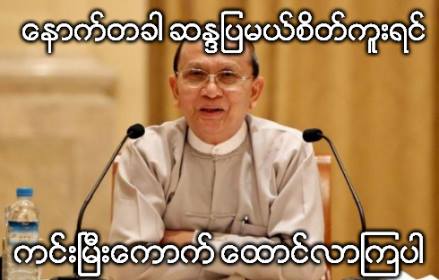
News of the woman's death infuriated many in Myanmar. Students in Yangon, the country's former capital, quickly organized an assembly to express their indignation. Meanwhile, netizens responded with witty memes targeting the government and the People's Republic of China.
Somael Celestial asked President Thein Sein a sarcastic question via a “Condescending Wonka” meme:
Top Text : The Big guy who wish to be re-elected if the public would agree Bottom Text : Tell me more about how the woman shot dead at head could vote for you
Top text: The big guy who wants to be reelected if the public would only agree
Bottom text: Tell us more how a woman shot dead in the head could vote for you
Nga Paing wondered about the initial report that said police shot at the woman's leg, but accidentally hit her head instead.
Top Text : The very first country that invented "shot-leg-hit-head" gun Bottom Text : Myanamr
Top text: The very first country to invent the “shoot-leg-hit-head” gun
Bottom text: Myanmar
Using “Sheltered Suburban Kid”, Min Sat Paing created a meme about those who look down upon those struggling in rural areas.
Top Text : In order to get shot Bottom Text : She would have done something stupid
Top text: In order to get shot
Bottom text: She must have done something stupid
 အင်ဘရန် လတောင် also made a meme about the life of villagers who lost the right to keep their land when the government steps in to claim it:
Top text (The woman says): I guess it's alright not to sell our farms if we don't wish to?
Middle text (The guy says): What? Your farms?
Bottom text (The guy says): Even Nay Pyi Daw [Capital of Myanmar] must be sold if China wants it!
စက္ကန်း ကမ္မင်း has advice on how to avoid being killed by a bullet that targets the leg but hits the head instead. Using a locally famous meme template known as “Bad Advice Thein Sein”, the advice is quite simple but hilarious:  
Top Text : If you are thinking to protest in future Bottom Text : Please come in handstand position
Top text: If you are thinking about protesting in the future
Bottom text: Please come in a handstand position
As there are unconfirmed news reports that Chinese armed personnel were also involved in the clash, Somael Celestial wondered about the status of his country.
Top Text : Not sure if it was Republic of Union of Myanmar  Bottom Text : Or Republic of China's Myan Dian [Myanmar in Chinese]
Top text: Not sure if it's the Republic of the Union of Myanmar
Bottom text: Or the Republic of China's Myan Dian [Myanmar in Chinese]
Wanbao mining company described the death of the protester as “senseless” and has asked the police to investigate the issue. Meanwhile, protests are continuing against the copper mine project.

China 'Regrets' Protester Death at Myanmar Copper Mine


                     Villagers try to comfort a weeping woman, a relative of Khin Win, who was fatally shot Tuesday during a confrontation 
                                                     with a police and mine security guards at Letpadaung copper mine.

China on Wednesday expressed "concern and regret" at the death of a protester outside a Chinese-backed copper mine in Myanmar, also known as Burma.
On Monday, a woman was killed and 20 others were injured when police fired on protesters at the Letpadaung Taung copper mine.
The protesters object to the expansion of the mine. They say it is built on land unfairly taken from locals and could harm the environment.
Chinese foreign ministry spokeswoman Hua Chunying said Wednesday that Beijing hopes the dispute can be "properly handled as soon as possible."
"China's government has consistently required Chinese enterprises with investments abroad to respect other countries' laws and regulations, well exercise social responsibility and obligation, and place importance on protecting the environment," said Hua.
Myanmar Mine ProtestMyanmar Mine Protest
Wan Bao, the Chinese company that runs the copper mine, also expressed sympathy for the woman killed, saying her death was "senseless."
Despite the calls for calm, violence continued Tuesday, when at least two people were hurt in protests.  
A local resident who wished not to be identified told VOA's Burmese service that protesters were met by an aggressive security force Tuesday.
“In the early morning, around 2,000 security forces and Wan Bao security guards attempt to fence off land for mining project, and local villagers want them to stop the attempt. Two villagers were seriously injured due to the shooting then,” said the local.
The U.S. State Department told VOA it is deeply concerned about reports of casualties during protests at the Letpadaung Taung Copper Mine.
The department said it has urged all parties to exercise restraint, and it called on Burmese authorities to conduct an “expeditious and transparent investigation” into the violence.
The executive director of Human Rights Watch’s Asia division, Brad Adams, told VOA the Burmese government needs to allow an independent investigation into the woman’s death and hold those responsible accountable.

VOA News

Monday, December 22, 2014

Army Officer Jailed For Endorsing Constitutional Reform in Myanmar

A Myanmar military officer was on Friday ordered jailed for two years for signing an opposition-led petition calling for amendments to the country’s military-drafted constitution in what is believed to be the first case of its kind since the country began embracing reforms more than three years ago.
Major Kyaw Zwar Win has been under detention since April, and his family was not allowed to visit him during the eight months he was under custody.
He said after the conviction by a military tribunal that he was being punished for violating military rules.
“I was charged under Article 65 of the military code for violating military rules and under Article 41(E) which is for disobedience of a military order,” he told RFA’s Myanmar Service as he was leaving the tribunal hearing in the town of Pyin Oo Lwin, 67 kilometers (42 miles) from Mandalay in the north of Myanmar.
“I was sentenced to jail because I signed the petition while the NLD [National League for Democracy party] was collecting signatures for the constitutional amendment,” he said while about to be taken to Obo Prison in Mandalay.
“There is an order in the army to not get involved in amending Article 436, and I was given two-year imprisonment because I signed the petition.”
Article 436 of the constitution effectively gives the military, which controls 25 percent of seats in parliament, a veto over constitutional amendments, since it requires more than 75 percent of parliamentary representatives to approve any changes.
Opposition leader Aung San Suu Kyi has said that getting rid of the military’s veto is the first step needed to pave the way for other amendments that can speed up political reforms in the country.
Kyaw Zwar Win, was arrested in early April by the military on the same day he was photographed signing the petition, which eventually drew about five million signatures.
The petition was initiated by opposition leader Aung San Suu Kyi’s NLD party and the influential activist 88 Generation student group which called on people nationwide, including military personnel, to back the signature campaign.
The NLD and Generation 88 student group also have called for amendments to Article 59(F), which prohibits Aung San Suu Kyi from becoming president because her two sons are not citizens of Myanmar.
Arrest and detention
Kyaw Zwar Win, a graduate of the Defense Services Technological Academy, was working for an engineering unit in Pyin Oo Lwin, where campaigners were collecting signatures, according to a report by The Irrawaddy.
He said he was not permitted to have visitors or read any material while he was detained for nearly eight months while awaiting a decision by a military tribunal.
One of Kyaw Swar Win’s relatives told The Irrawaddy in late November that the soldier signed the petition at the request of a friend who was an NLD member, but did not know exactly what the document was.
The military had initially denied that it arrested him in connection with the petition and had spread the word that he was detained for releasing a corporal who had deserted his unit in western Myanmar’s Rakhine state, according to The Irrawaddy report.
The military, however, already had taken disciplinary action against him for the Rakhine state case in July, one of Kyaw Swar Win’s family members told the online journal.
The soldier’s sentencing comes amid debate following parliament’s call for six-way talks among Aung San Suu Kyi, President Thein Sein, the speakers of the two houses of parliament, military chief Min Aung Hlaing, and a member of a party representing ethnic minorities to discuss changes to the constitution.
Thein Sein has not officially responded to parliament yet, but his spokesman had said that the talks would be “impractical,” prompting speculation that the president and military lawmakers are reluctant to discuss amending the constitution.
Lawmaker Min Thu of the NLD told RFA this week that military representatives in parliament sent a letter to the party, saying they wanted to meet with Aung San Suu Kyi during upcoming parliamentary meetings.
They intend to invite her to dinner to forge better ties and said they would let the NLD know about the date, he said.
Earlier, the military lawmakers declined a dinner invitation from Aung San Suu Kyi.
Reported by Aung Ko Ko from RFA’s Myanmar Service. Translated by Khet Mar. Written in English by Roseanne Gerin.

Catholic group says Myanmar government blocking aid deliveries


Border camps in Kachin state see blockade of assistance convoys as skirmishes continue
<p>A Kachin woman and her child inside the IDP camp in Myitkyina, Kachin state's capital on December 5 (Photo by John Zaw )</p> A Kachin woman and her child inside the IDP camp in Myitkyina, Kachin state's capital 
on December 5 (Photo by John Zaw )

Myanmar's government is restricting humanitarian access to thousands of people living in camps on the Chinese border amid heightened tensions between government forces and ethnic rebels, a local Catholic aid group says.
The Myanmar army shelled the Kachin Independence Army (KIA) headquarters at Laiza on November 19, killing 23 trainees from a variety of ethnic armed groups active in Myanmar's border regions.
The attack has put in doubt already stalled negotiations toward a nationwide ceasefire agreement and has been widely denounced, despite the military's claims the mortar strike was "unintentional".
Skirmishes have flared up in Kachin state and northern Shan state since the attack, but large-scale fighting has not taken place.
Aid workers say the government is now blocking United Nations convoys that have since June 2013 delivered supplies to internally displaced people living in rebel-administered camps on the mountainous Myanmar-China border. These camps house about half of the 99,000 people who have fled their homes during the conflict since a 17-year ceasefire broke down in 2011.
Father Noel Naw Lat, director of Catholic Church-backed Karuna Myanmar Social Services' Myitkyina branch, says that the government has claimed travel authorization for international aid convoys could not be granted for "security reasons".
Karuna Myanmar and the Kachin Baptist Convention, which have been providing aid to internally displaced persons (IDPs) in northern Myanmar since 2011, are still able to reach the camps. But Fr Noel Naw Lat said that camps close to Laiza that are not directly administered by either of the local Church organizations would soon be low on supplies without further UN assistance.
"From next month, we don't know what we will do," he said, adding that about 20,000 people were residing in such "no man's camps" around Laiza.
In an emailed response to ucanews.com, Pierre Peron, spokesman for the UN's Office for the Coordination of Humanitarian Affairs in Yangon, declined to say whether the UN was being prevented from delivering aid to the camps, but did confirm that the last international convoy traveled in September.
"International organizations support and supplement the activities of local NGOs by providing assistance and technical support through cross-line convoys. These cross-line convoys are cleared through administrative procedures involving both the Myanmar authorities and the KIO, and we are currently waiting for the finalization of this process," Peron said.
He said the UN was "working closely with the authorities and local NGOs to find solutions to ensure that aid reaches all people in need, whether in camps or in host communities".
The recent uptick in incidents in northern Myanmar comes at the end of the least violent year in the current conflict. The government and the Kachin Independence Organization, the KIA's political wing, had earlier in the year agreed to form a joint peace-monitoring group and begin a pilot project to resettle the displaced.
Nshang San Awng, a member of the Peace-talk Creation Group, an organization based in the state capital Myitkyina that mediates between the Kachin rebels and the government, said that trust had been deeply damaged by the recent attack on Laiza.
"Almost all the Kachin people believe following this attack that the military has no commitment to getting peace," he said. "They are saying the words, but the actions don't follow."
Locals were worried by increasing numbers of government soldiers in the state since the attack, he added.
Ja Tawng, 43, a mother of seven who has lived at the St Paul Ja Mai Kaung camp in Myitkyina since fleeing her village in Wai Maw township in 2011, said the Laiza attack was a blow to displaced people hoping to resume their normal lives after some two-and-a-half years in temporary shelters.
"There were signs we could go back to our land soon, but now we doubt it," she told ucanews.com.
"More fighting is happening, and we see that the situation is worsening again."

Letpadaung Farmers Protest Over Bulldozed Crops, Fenced-Off Land

burma-copper-mine-april-2013.png
Farmers in northern Myanmar staged a fresh protest against the China-backed Letpadaung copper mine on Friday after authorities bulldozed crops and fenced off farmland as part of the project’s controversial expansion program.

Local residents have refused compensation offers for land confiscated for the Sagaing region mine, where operations resumed this month after a government-ordered hiatus prompted by a brutal crackdown on local protests last year.

Since early this month, security guards have fenced off some 200 acres (80 hectares) of farmland developed by local residents and destroyed another 100 acres (40 hectares) of crops, according to residents.

Some 300 farmers protested in front of the Chinese project operator Myanmar Wanbao Copper Mining Limited’s local communication office to demand compensation for the destroyed crops, which they said were worth about 300,000 kyat (U.S. $300) per acre.

Local mining and security officials had the crops destroyed and fences built in a bid to get residents to give up their claims on the land, they complained.

“[They] had fences built around our land and had our crops destroyed on land that we had refused compensation for,” local protester Ma Sanda of Ton village told RFA’s Myanmar Service.

“They are clearing the crops on the fields by driving bulldozers across the land. So local farmers are demanding compensation for the damaged crops,” she said.

Local tensions

Residents calling for a complete halt to the project have staged regular protests against the project in recent months, resulting in frequent standoffs with police.

Officials have allowed the Wanbao company to resume operations without fulfilling requirements set by a parliamentary commission that reviewed the project, they complained at protests this month.

President’s Office Minister Hla Tun, who heads the committee charged with implementing the recommendations, held a meeting with local residents last week but it did little to ease the tensions.

“We have lost our trust in the implementation committee,” Ma Sanda said.

Land compensation refused

The parliamentary review commission, headed by opposition leader Aung San Suu Kyi, had recommended earlier this year that the project be allowed to continue with safeguards and higher compensation offered for confiscated land.

But residents have said the new rates are still too low to make up for the loss of their farmland and livelihoods, refusing the offers and allowing the Sept. 30 compensation deadline to lapse.

The commission’s inquiry, prompted by a national outcry over the brutal police clampdown that injured dozens of anti-mine protesters in November,  also resulted in a revised deal for the mine, which was initiated under Myanmar’s former military junta regime.

In an apparent bid to assuage public anger by giving the nation a share of the profits, the agreement was updated in July to give the Myanmar government 51 percent of the mine’s revenues, 30 percent to Wanbao, and 19 percent to the Myanmar military-backed Union of Myanmar Economic Holdings (UMEHL).

The new terms also stipulate that two percent of net profits from the project go toward corporate social responsibility with a focus on immediate communities.
RFA

Reported by Nay Rain Kyaw for RFA’s Myanmar Service. Translated by Khet Mar. Written in English by Rachel Vandenbrink.

Protester shot dead during clash with police near Myanmar mine


Violence erupted Monday as villagers tried to prevent a Chinese company from fencing off their land
<p>Protesters march near the Letpadaung copper mine in Sarlingyi township, Sagaing on March 13, 2013 (AFP Photo)</p> Protesters march near the Letpadaung copper mine in Sarlingyi township, 
Sagaing on March 13, 2013 (AFP Photo)

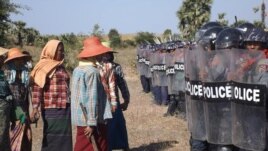
A protester was killed and at least 10 injured on Monday during a clash with riot police near the site of a controversial Chinese-backed copper mine project in northwestern Myanmar, as they tried to prevent their land from being fenced off by the mine’s operator, sources said.
The woman, Khin Win, had joined around 60 farmers from Myogyopin, Sete and Tonywa villages in the country’s Sagaing division trying to stop contractors hired by Myanmar Wanbao Mining Copper Ltd from erecting a fence around farmland which they said they had not received compensation for.
Zaw Myint Than from Myogyopyin village told RFA’s Myanmar Service that Khin Win, who was in her 50s, “died from a bullet to the head” after police fired rifles on farmers who threw rocks and launched slingshots at them, though it was unclear whether she was shot by police or mining company security personnel.
He said around 600 police officers had been deployed to the site ahead of the clash.
Another villager, Thwe Thwe Win said police had threatened to fire on protesters while the clash was underway.
“The commander … ordered his officers to fire on me if I came forward and I told him that I would oblige him if he wanted to shoot me,” she said.
“The worst thing was that the Chinese workers beat the villagers with the hammers they brought to erect the fences. The local people were wounded and couldn’t even walk.”
Sources said at least 10 protesters were injured, though some reports put the number as high as 20.
Two officers were also injured, according to a report in the Irrawaddy online journal.
Villagers told the journal that police had increased their presence in the area during the previous week as Wanbao sped up land demarcation for the project.
‘Still unclear’
Wanbao acknowledged that a woman had been killed, but said the events surrounding her death “are still unclear,” according to a statement on its website which also extended the company’s condolences to the woman’s family.
“We understand the police were also at the scene, and we hope they will start investigating this tragic event.”
The company also called the incident “awful given the great turnaround in our relationship with our community.”
“We have achieved amazing progress because we received popular approval for our project through two large community consultations carried out from May until November 2014,” the statement said, adding that Wanbao had been able to begin construction because “the vast majority of the people gave us the OK to proceed.”
“We are unwavering in our commitment to peaceful dialogue, and we condemn any violent and dangerous activity that jeopardizes the safety of the villagers, the protestors, our staff or the police,” it said.
The statement followed another one issued by Wanbao on Monday, saying that it would commence construction of the Letpaduang project by extending its working area to comply with requirements of its investment permit granted by the Myanmar government.
“The company hopes that, with the commencement of construction, the Letpadaung project can reach ‘operational status’ soon where the company can continue sharing the benefits of this project with its community and the whole of Myanmar,” the statement said.
Min Ko Naing, leader of the student movement in Burma in 1988 and an influential political activist, told RFA Monday that he planned to travel to Letpadaung with a medical team to help farmers who were injured in the melee.
“We are not only helping them, but also speaking out about our disagreement over this kind of violence,” he said. “As it is based on business interests, the investors and their governments should think about a peaceful way to invest.
“We have to find a way to solve these problems [because dealing with issues] like this will lead to bigger problems in the future.”
Residents displaced from their farmland in the areas surrounding the mine project have protested previously about the lack of fair compensation for their confiscated lands as well as environmental destruction and the defilement of religious structures.
The copper mine is a joint project between Wanbao and the Union of Myanmar Economic Holdings, one of two major conglomerates run by the military through the defense ministry.
Another violent showdown between villagers and police occurred in November 2012 when officers used smoke bombs containing phosphorus — a highly flammable chemical — to break up protests against the copper mine project. Dozens of anti-mine protesters were injured in the incident.
The company has said that since 2011, the project’s partners have offered villagers who lost land in the project area three rounds of compensation, the amount of which was determined by the Myanmar government based on laws and local market prices.
But not all villagers have accepted the offers, saying they were inadequate, and have refused to vacate the land.
RFA.
Reported by Way Yan Moe Myint, Nay Rein Kyaw and Khin Pyae Son. Translated by Khet Mar. Written in English by Roseanne Gerin.

In Myanmar’s ‘Black Areas’, civilians are in the army’s crosshairs

Simon Lewis and John Zaw
Dec,22.
Government's military strategy in Kachin state draws from decades-old
 policies targeting the innocent

<p>People displaced by fighting in northern Myanmar have been living for more than three years in temporary camps in the Kachin state capital, Myitkyina (Photo by Simon Lewis)</p> People displaced by fighting in northern Myanmar have been living for more than three years
 in temporary camps in the Kachin state capital, Myitkyina (Photo by Simon Lewis)

When fighting broke out in northern Myanmar in June 2011 between ethnic Kachin rebels and the government army, U Law Lu Lum heard that government soldiers were on their way.
The 50-year-old lay catechist led fellow villagers into the scrub around Malisu Yang village, hiding out while troops looted stores and burned farmland on their way to the front line.
Sticking around was not an option.
“They suspect that every Kachin is an enemy, no matter how old, or if it’s a man or a woman,” he told ucanews.com at a camp made up of cramped bamboo huts in the Kachin state capital, Myitkyina, where most of the village’s former residents have lived ever since.
They are among about 99,000 people displaced by fighting in Kachin state and northern Shan state since hostilities resumed between the military — known as the Tatmadaw — and the Kachin Independence Army (KIA).
Not everyone got away, however.
“When the military found civilians, they took some of them as porters. But there was also a 70-year-old man in the village who was too old to flee. The military found him and suspected him of helping the KIA. So they killed him,” he said.
“They didn’t kill him at once, but we heard he was tortured to death.”
In the camps for the displaced, most people have similar stories that have filtered out from what are termed “black areas” in a color-coding system employed by the army in conflict zones. White areas are under central government control; brown areas are contested.
The dreaded black areas are where ethnic rebels lie in wait, ready to ambush government troops on the roads and in village tracts. But when government troops come across civilians in black areas, they act with impunity, leading to reports of looting, forced labor, rape and summary executions.
“If more of us had stayed, we would have been killed too,” said U Law Lu Lum. “This is a war — even if we make a complaint, the military won’t take any action.”
'Women, children and the elderly'
U Gun Zaw, 43, comes from a rugged area close to Myanmar’s border with China. When troops came through his village — close to the KIA’s mountain headquarters at Laiza — he managed to flee on foot before hitching a ride to Myitkyina, where he has relatives.
A friend was not so lucky, he said.
“He fled to Laiza instead of here, but he tried to go back to the village,” U Gun Zaw said. “When he went back, military reinforcements were coming through. They suspect every civilian, so they shot him dead.”
Testimony from the displaced suggests that the Tatmadaw’s tactics for fighting the country’s decades-long ethnic insurgencies have changed little since the country emerged from outright military rule in 2011.
“I spoke with several former soldiers who described the orders they were given in black areas,” Harvard School of Law researcher Matthew Bugher told reporters in Yangon in November, “and they said that they were told everyone that was in that area was to be considered the enemy.”
“Everyone includes women, children and the elderly.”
Bugher was presenting the findings of a 77-page legal memorandum by the International Human Rights Clinic at Harvard, which lays out in detail a Myanmar army offensive in Karen state in 2005-08.
The researchers claim to have collected evidence that implicates three commanders — including the current home affairs minister — in war crimes and crimes against humanity for targeting civilians.
Since that offensive, a civilian government has taken the reins in the country. The 2008 constitution in theory gives some degree of oversight on security issues to senior civilian politicians — though most of them happen to be former generals.
Fighting between the government and the KIA — as well as ethnic Palaung, Shan and Kokang rebels — has raged almost since the self-styled reformist administration took power. Talks on a nationwide ceasefire agreement are continuing in Yangon this week, but had seemingly stalled even before a government mortar attack on Laiza in November killed 23 young cadets from a number of ethnic armies who were undergoing training.
The displaced look unlikely to return home soon, as even areas that have not seen fighting for more than a year remain highly militarized.

Researchers say the military's offensive has indiscriminately targeted civilians, including women, children and the elderly (Photo by Simon Lewis)

Shoot on sight
"That whole area is a black area,” says Father Vincent Shan Lum, waving his hand over most of northeastern Kachin state on a map. The area represents the foothills of the Himalayas, and is accessible to the rest of the country only by a single road, or by river.
Father Vincent is the former parish priest of Sumpra Bum town, along the route north from Myitkyina. In 2011 and 2012, he said, the military emptied all the villages on either side of the road in order to cement its control.
The soldiers were highly suspicious of anyone traveling through — even a priest in his cassock.
“The soldiers are very humble up to Myitsone [the confluence of the rivers that become the Ayeyarwady]; they don’t do anything. But after passing there, they act like beasts,” he said, recalling two occasions when he was quizzed at gunpoint.
Southeast Asia-based Fortify Rights has documented numerous abuses by government troops in the conflict. Most attacks have occurred in areas with no KIA presence, suggesting they are designed to cut off the group from civilian support and secure control of trade routes and Kachin state’s copious natural resources.
“We've documented what appears to be a shoot-on-sight practice by the Tatmadaw in certain areas of Kachin state,” Fortify Rights executive director Matthew Smith said by email.
“Unarmed civilians learned the hard way that if they were in certain contested areas, the army would open fire on them. In the last year we've interviewed survivors and witnesses of such attacks. I've personally interviewed numerous people who survived such attacks.”
"At its core the army is an unreformed institution. Sadly many of its core competencies still appear to be in violation of the laws of war.”
Similar tactics have been a key part of Myanmar’s counter-insurgency campaign for decades.
“Its very clear that this black area policy is sort of the grandchild or the child of the ‘Four Cuts’ doctrine and that it embraces the same ethos, which is: the sanctioning of civilian targeting as a way to combat insurgency,” said Harvard researcher Bugher.
“Four Cuts” was developed by the Myanmar army in the late 1960s as it battled the now-defunct Communist Party of Burma as well as the ethnic armed groups. It entails cutting rebel groups’ access to the four needs of food, funds, new recruits and information, largely by removing the civilian population in their areas of activity.
The historic policy, also known to some as “no man’s land,” was characterized by the army sweeping through the area — with the results the same as those seen more recently in the north.
A policy memorandum published by the clinic earlier this year said the designation of black areas contravened international law as it predictably lead to attacks on civilians.
“This practice constitutes a per se violation of the principle of distinction, a fundamental tenet of international humanitarian law which requires that combatants distinguish between civilian and military targets,” the memorandum said.
“Myanmar’s military justice system, which lacks civilian oversight, has consistently failed to hold military personnel responsible for abuses of civilians, leading to an atmosphere of impunity throughout the military’s ranks. Moreover, military leadership has rewarded improper conduct by routinely promoting senior commanders who have overseen large military offensives in which civilians were targeted en masse.”
The military — which does not have a functioning spokesperson — and the government have both so far rejected all calls for accountability, with the deputy defense minister reportedly dismissing the Harvard memorandum as “one-sided and inaccurate”.
Rights groups say that Myanmar’s ethnic armed groups have also committed abuses in the conflicts, but on a far smaller scale.
Dr Tu Ja, a former Kachin Independence Organization cadre turned civilian politician, told ucanews.com that accountability for the actions of military commanders in northern Myanmar would be “an issue for the future”.
“Myanmar people excuse others’ mistakes easily. The people will not be eager to punish them,” said Dr Tu Ja, who now heads the Kachin State Democracy Party.
However, he said, “If [their acts] are inexcusable, they should be punished,” suggesting that researchers may one day begin digging into recent offensives.
“In the future, we can’t guarantee that there won’t be a local or an international research team,” he said. “Therefore, some of the military leaders should be worried.”